


Two Coastal Virginia venues where quiet luxury speaks volumes.
By Betsy DiJulio
Quiet Luxury” isn’t necessarily quiet. And it isn’t necessarily expensive.
So, then, what is it?
Hardly new to the wedding party but given a name and gaining traction in the last couple of years, quiet luxury is a term that is perhaps best defined by what it isn’t. Weddings that are quietly luxurious are not ostentatious, overtly extravagant, or flashy. They eschew over the top excess for a highly personal, yet timeless and understated approach to elegance.
Not a single style—far from it—quietly luxurious weddings are focused more on simplicity, authenticity, and intimacy. These bespoke occasions lean into the bride and groom’s story: their connection to each other, to a place, to their friends and family, or maybe even their dog. Personal significance drives every decision, from setting to invitations, menu, décor, attire, and all the subtle, high-quality details.
These nuptials feel effortless, gracious, and grounded. The ceremony and everything leading up to it and following are an expression of the lives of the two people who have chosen to spend theirs together. While the flow may be orchestrated—though never formulaic—it doesn’t feel that way. Rather, the vibe is intentional and caring, focused on the values of the couple and the experience of their guests and, sometimes, their community, as charitable giving and environmental sustainability are often folded into these celebrations.
At a quietly luxurious wedding for 50 at a rustic marina, one coastal bride set out a basket of large bleached clam shells with a gold paint pen in lieu of a guestbook and painted small abstract seascapes for the wedding party and overnight guests. But quiet luxury weddings look as different as the people marrying. Whether casual or formal, these celebrations reflect who the couple is and what they care about. While it’s difficult to say what drives this direction, those in the know attribute it, in part, to a desire for emotional intimacy and meaningful connections instead of a curated social media spectacle.
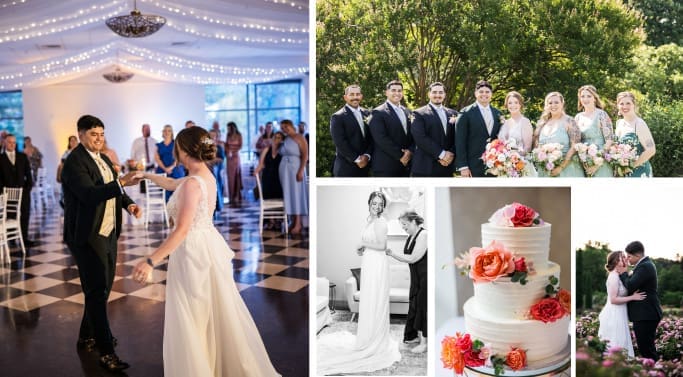
Here we highlight two properties in Coastal Virginia that lend themselves to this brand of wholehearted matrimony.
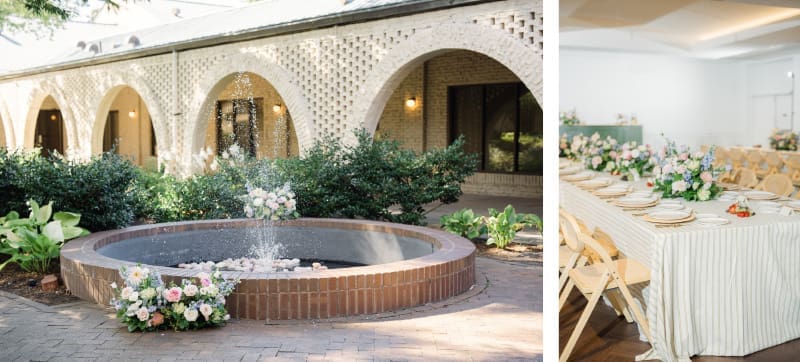
The South Courtyard of the 1930s era Mariners’ Museum in Newport News is a lush, cultivated microcosm of the surrounding 550-acre urban oasis. Against a backdrop of maritime artifacts, the courtyard is enclosed by white perforated brick arcades, crisscrossed by winding stone pathways, and punctuated by graceful trees and a burbling fountain. This intimate al fresco space is softened by swaths of green lawn, evergreen flowering shrubs, and seasonal plantings. In the evening, lanterns light the way.
Founded by Archer Huntington, the museum boasts sculptures by Anna Hyatt Huntington, his sculptor wife. Both indoors and out, the wildlife sculpture for which she is best known lends a hint of timeless formality, but one that is dynamic rather than static and places this secret garden squarely at the intersection of natural beauty, maritime history, and art.
Often noted as the oldest brick church in Virginia, St. Luke’s Historic Church and Museum in Smithfield is, in fact, the oldest brick church in America. Dating from 1685, and renovated twice, “The Old Brick Church” offers simple elegance steeped in history. In the 1950s, Dwight D. Eisenhower awarded Historic St. Luke’s with a National Shrine designation, only one of two sites in the nation to receive this designation by a U.S. politician. Having weathered hundreds of years of America’s historical and political history, it stands as a symbol of love that endures throughout time.
The church’s red brick Gothic inspired exterior—with other notable influences from English “Artisan Mannerism” and Jacobian styles—offers a simple, but softened, geometry punctuated with traditional lancet windows and a picturesque tower. Iconic stained glass windows illuminate the interior while arched openings frame views of the property’s 100 acres, home to ponds, gracious old trees, and three historic cemeteries.
The interior is characterized by dark, gleaming wood, exposed beams, whitewashed plaster walls, and cobbled floors. Its late Medieval style rood screen separates the nave from the chancel and is rendered magical when topped by candles and cascading flowers.
No longer with an active congregation or affiliation with a specific religion—though it was once Anglican and then Episcopalian—St. Luke’s takes pride in its inclusive approach to those wishing to marry. People of all faiths and sexual orientation are welcome to celebrate their love in this place where the roots of religious freedom run deep. ⁄
Mariners’ Museum,
South Courtyard, 100 Museum Drive, Newport News,
(757) 596-2222
marinersmuseum.org
St. Luke’s Historic Church and Museum,
14477 Benn’s Church Boulevard, Smithfield,
(757) 357-3367
contact@stlukesmuseum.org
PHOTOGRAPHY
Jacob and Brielle Photography
@jacobandbriellephotography
www.jacobandbriellephotography.com
FLORALS
Aster & Bee
@asterandbeefloral
asterandbeefloral.com
RENTALS
Curated Events Chesapeake
@curatedeventschesapeake
CAKE
Classic Confections by Julia
@ccbyjulia
